3 min read
Mastering Software Architecture & Design Patterns: A Comprehensive Guide

Software architecture is not just about writing code; it's about the strategic decisions that determine a system’s longevity, scalability, and maintainability. This guide covers the essential terminology and patterns every developer should master.
Before diving into patterns, we must understand the "physics" of software design.
These two concepts define the health of your module boundaries.
Rule of Thumb: Aim for High Cohesion and Low Coupling to ensure your system is easy to refactor.
In distributed systems, you can only guarantee two out of three:
Creational patterns abstract the instantiation process, making a system independent of how its objects are created.
Ensures a class has only one instance and provides a global point of access.
Defines an interface for creating an object but lets subclasses decide which class to instantiate.
Separates the construction of a complex object from its representation.
These patterns explain how to assemble objects and classes into larger structures while keeping them flexible.
Allows incompatible interfaces to work together. It acts as a wrapper between two different systems.
Attaches new behaviors to objects dynamically by placing them inside special wrapper objects.
Behavioral patterns are concerned with algorithms and the assignment of responsibilities between objects.
Defines a subscription mechanism to notify multiple objects about any events that happen to the object they’re observing.
Defines a family of algorithms and makes them interchangeable.
While design patterns solve local problems, architectural styles solve global ones.
| Pattern | Category | Main Intent |
|---|---|---|
| Singleton | Creational | Only one instance exists. |
| Builder | Creational | Step-by-step complex construction. |
| Adapter | Structural | Makes incompatible interfaces talk. |
| Decorator | Structural | Add behavior without inheritance. |
| Strategy | Behavioral | Swap algorithms at runtime. |
| Observer | Behavioral | One-to-many notification. |
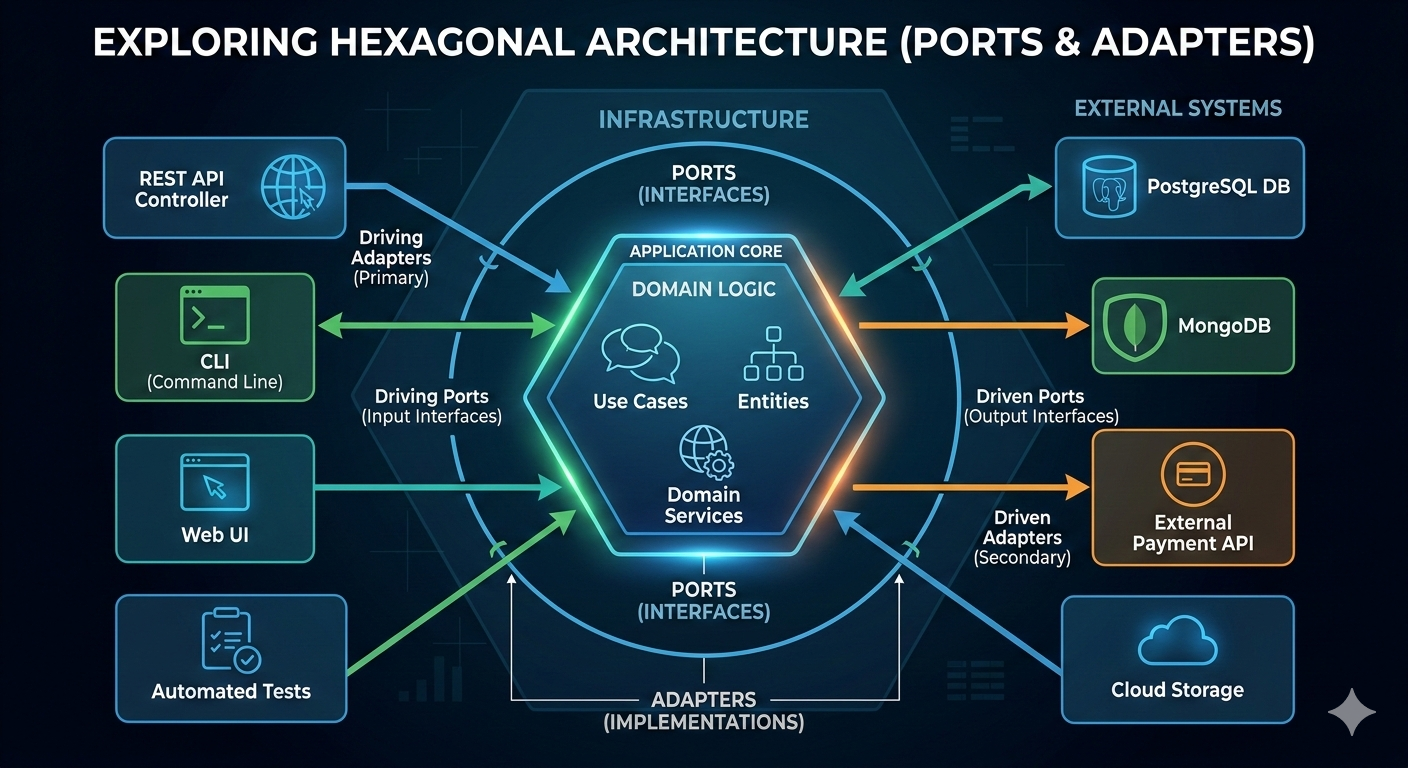
Presentation Layer: UI and API Controllers.
Business Layer: Core logic and rules.
Persistence Layer: Database interactions.
Database Layer: The actual data store.
UserPizza